Scaling UDL Across Your Campus: From Permitted to Expected with Dr. Tom Tobin
In this episode, we sit down and talk with Dr. Tom Tobin about how to scale UDL efforts within your university. Tom will walk us through step-by-step with how to set up your UDL initiative to be successful with supporting efforts, overcoming challenges, establishing reward systems, and more. We also chat about case studies of UDL champions within universities and the effectiveness of the FAST framework.
Digram Tom refers to in the episode:
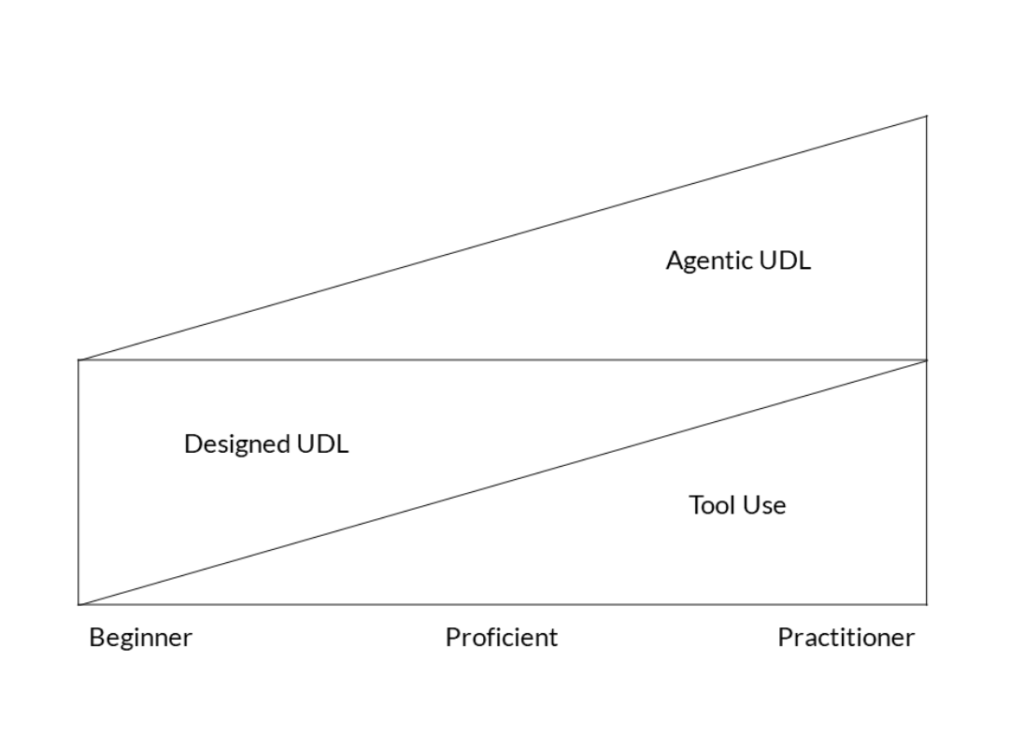
Tom’s lopsided house
A tremendous thank you to our sponsors! By supporting them, you support this independent podcast.
The Instructional Design, Engagement, and Support (IDEAS) website provides information and resources to help all members of the UMass Amherst community with online teaching and learning technologies.
Brightspace by D2L
Try D2L Brightspace for 30 Days. Get instant access and see for yourself why millions love Brightspace
Transcript
Luke: Tom, welcome back to the podcast. How are you?
Tom Tobin: I'm doing well. Good to see you, Luke.
Luke: Likewise, man. Likewise. It's been almost three years since your last podcast episode. I had to look it up. And for the folks who maybe didn't listen to that last episode (and obviously they should go back after this), would you mind once again introducing yourself? Tell us more about who you are and what it is that you do.
Tom Tobin: Well, thank you, Luke. It's a pleasure to come back and talk with you and your listeners again. Everybody, I'm a tall white man with gray hair, glasses, and a giant black mustache. In my everyday work, I'm a scholar, author, and speaker on quality in technology-mediated education. What that means is things like copyright, how we evaluate teaching practices, academic integrity, accessibility, and our topic for today, Universal Design for Learning.
My career focuses on extending higher education beyond our traditional audiences. I advocate for the educational rights of people with disabilities and people who have disadvantaged backgrounds. I spent five years as the coordinator of learning technologies at Northeastern Illinois University, then seven years on the Learning, Talent, and Communication team for Blue Cross and Blue Shield, so I went into industry for a while, and then four years as the program area director for Distance Teaching and Learning at the University of Wisconsin–Madison.
And then I helped found the Center for Teaching, Learning, and Mentoring at UW–Madison five years ago as well. And Luke, you're talking to me at a fun time, because I just retired from UW–Madison earlier this year. These days, I'm focused on working with colleges and universities all over the world to help them lower access barriers and address persistent challenges. So, to tell the truth, I'm busier now than when I was working for a university.
Luke: Yeah, sounds right. Hey, congratulations, by the way. That's wonderful. We didn't talk about that before, so congrats. Well, Tom, I had to bring you back onto the show because, first and foremost, I'll tell all the listeners at home that my wife and I have been thinking about creating a writing retreat. When I put it out into the universe that we were thinking about this new type of retreat, and that we didn't know what we were doing, you were one of the first people to say, "Hey, I have experience with this. You want to chat? Do you want to go back and forth on this idea?"
So, as always, I appreciate your friendship and your advice over the years. I always think about you when I'm starting some new type of academic adventure, and I ask myself, "What would Tom do in this situation?" So you always come to mind, and I always appreciate your time. And whenever I see you working on a new project, like writing a new book, I think, "You've got to come back on the show, man." This book, which is called UDL at Scale: Whole-Campus Universal Design for Learning, I just finished reading last night. Hence why I sent you the questions so late, because I couldn't put the book down. You did a phenomenal job with this book. And I'm not just saying that because you're literally on the show and you're a two-time guest. You really, really outdid yourself with this one. Because you've written so many books before, I'd love for you to explain what separates this book about UDL in particular from other pieces that you've written in the past.
Tom Tobin: Well, Luke, thank you for having me back on. Thank you for reading the book. Thank you for just being a good thought partner. I love celebrating the work of people who are out there trying to help lower barriers for others, and it's one of the things that I really admire about the work that you do. And listeners, this is one of the things that we can all help each other do. This is why I wrote this book. Most advice about Universal Design for Learning, or UDL, is aimed at individual practitioners, my previous two books included. We ask instructors or developers or designers to take on the burden of making all of our materials and our learning experiences more accessible. It's not a surprise, when we put those demands only on instructors' shoulders, that only about 10% of instructors, designers, and professionals in higher education are using any inclusive design methods at all, let alone a specialized framework like UDL.
This book is a very different argument from the ones that I've made in other places. In the past, I was helping people understand what Universal Design for Learning even is. Higher education was slower to know about and adopt UDL principles than folks in our elementary, middle, and high school areas.
And I was also helping people take almost a step zero, right? Universal Design for Learning is a fairly complicated framework. I wanted to simplify it for everybody, to give people permission not to have known about it before, to take one little action, one little step, and try it out in their own teaching or their own design. I wrote UDL at Scale because I realized that we're never going to individual-effort our way beyond system-level barriers and challenges. And the more I thought about it, the more we see a lot of systemic barriers in colleges and universities. It's not just for people who have disability barriers in their environments, either. People just have, what? Work responsibilities, caregiving, military service. Our biggest challenge is usually the clock.
People are trying to fit their education into already busy schedules, and those are systemic challenges. Those are things that everybody faces at a college or a university. So asking each of us individually to do a whole bunch of work doesn't actually move the needle. And I recognized that if I was going to talk to thought leaders on campus who were advocates, and also department chairs, deans, provosts, vice provosts, vice presidents, presidents, and the board of trustees, I'd have to make a bit of a different argument. And that's what this book is all about. This book is not a social justice book. It's not "this is the right thing to do." This book is aimed squarely at the budget. It shows that when we adopt inclusive design practices, not just in the classroom but across all of our service touchpoints at a college or a university, it's actually a really good financial decision. It reduces rework, it lowers barriers, it helps students find resources more quickly and more effectively, and, for all of you campus leaders out there, it actually moves the needle on student persistence, retention, and satisfaction, the kind of stuff that keeps your provost up at night. That's why I wrote this one.
Luke: Hmm. It is a very, very different read. One person on LinkedIn was just asking me what separates this from other UDL books that have been written in the past, and you've definitely done a great job of explaining that. It's an actual practical application, a real toolkit for getting people in leadership roles to really care about this and for keeping the momentum going. And that's something I was thinking about in terms of how I've been teaching UDL over the years. I teach my University of Miami students about this, and something that I think will make you happy is that, as you were saying, we've moved past the stage of asking "What is UDL?" In what I think is the fifth week of the course, where I talk about UDL, I'll ask at the beginning, "Have you heard about this framework before? Give me a yes, give me a no." And every hand goes up saying, "Of course I have." And that makes me very happy, because when I first started teaching, that was not the case, and I had to explain what UDL actually is.
Now, with you, we have the information about what UDL actually is. But knowing about something and knowing how to implement the idea in the real world are two very different things. You know that this framework can be great, it can be effective, but actually taking action and making it happen within your university, growing it at a different scale, is a very different type of approach. So a question I'd love to ask you from that perspective is: why do you think there are still obstacles and barriers when it comes to adopting UDL? Folks know it can be great, know it can be effective, but those types of challenges are still there. Why do you think they still persist?
Tom Tobin: This is an excellent question, Luke. Listeners, while Luke was setting this up and talking about teaching his students, you couldn't see me, but I was nodding vigorously. The response to this question lets me say something that I didn't explicitly spell out in the new book, but that runs all throughout it. When we say Universal Design for Learning, most people now understand what we mean, at least in a general sense. They know the three principles of Universal Design for Learning: we should design our learning experiences with multiple means of engagement, multiple means of representation, and multiple means of action and expression. We need a why, a what, and a how in the learning process, and we need to give people more than one way to do those three general phases of the learning process. Now, in my earlier work on UDL, my goal was to come up with an even simpler starting point.
We can simplify UDL to just plus-one thinking: if there's one way for an interaction to happen now, make just one more way. And that idea really took off with people. But scratch that easy-to-understand surface, and things get tangly pretty quickly. And this is why there are still obstacles and barriers when it comes to adopting UDL. So, listeners, we're going to go on a deep dive, and I promise we'll come back up. Here we go.
The three principles of UDL break down into nine guidelines, which further contain a total of 36 UDL considerations. These are task- and design-level elements that help us apply the UDL principles in specific ways. Now, each of those 36 UDL considerations can be applied in ways that support learners whose skills are just emerging, getting proficient, and approaching practitioner level.
Katie Novak and Kristan Rodriguez outline those three levels in their UDL Progression Rubric. And for each of the three levels of each of the 36 UDL considerations, there are eight elements that contribute to the success of that effort. Kavita Rao and a team of researchers came up with the UDL Reporting Criteria in order to create a standardized way that we can design, observe, and measure the effectiveness of UDL implementations.
So, no problem, right? UDL is just three principles made up of nine guidelines that break down into 36 considerations, all of which can be crafted with 108 progression levels, and all of those can be observed through a total of 864 different reporting criteria. Easy to understand, right? It's no wonder that our colleagues can think that UDL is too complex for everyday work. So that's one reason why the barriers are there. And one more.
Add to this the expectation that individual instructors or designers will be responsible for implementing UDL in their own work, and we've got a recipe for not much. Basically, right now we're telling everyone, "Lower access barriers with UDL because it's a socially just thing to do, and because the work you put in now will save you and your students time and effort and fuss." But we're not taking any work off people's plates so they can focus on this work.
We're not providing funds, graduate assistants, teaching releases, or any other meaningful motivators. We're not training the support teams on campus in UDL practices so that they can help instructors with the work. And we're not checking to see how, how much, or how well people are applying the UDL principles to their work. So those are some of the big barriers right now.
Luke: Yeah. I'm not sure they'll go away anytime soon, as you kept mentioning. It's a work in progress, I would say. But not to focus on the negative. I'd actually love to focus more on the positive. Tom, do you have a favorite example of a university that has overcome a challenge and that you now consider to be a UDL champion?
Tom Tobin: Absolutely. And readers, when you take a look at the book, there are fifteen different colleges and universities all over the world that have done it. Not "we're trying it and we think this is an effective thing." They've got the data, they've been doing it for a couple of years, and they are UDL institutions. This new book really arose, Luke, out of two parallel developments.
I started working with colleges and universities on campus-wide efforts to adopt UDL a few years ago, so I was able to test out my ideas and bring my expertise into existing campus systems. In parallel, I also started learning about the efforts of other colleges and universities to become UDL institutions, and I talked with their project and program leaders to expand my understanding of what actually moves the levers at the very top levels of their institutions.
Out of all the places that have adopted UDL across their campus, the one that's most compelling for me is Atlantic Technological University, or ATU, in Sligo, Ireland. Back in 2021, I was working with AHEAD, which is a disability advocacy organization in Ireland, and I worked with the government of Ireland. We co-published a book called UDL for FET Practitioners: Guidance for Implementing UDL in Irish Further Education and Training.
The longest book title I've ever seen in my life. Now, listeners, further education in Europe is the equivalent of technical college and community college in North America. That book was structured around eight examples of how individual instructors applied the principles of UDL in carpentry, health sciences, dentistry, high school equivalency, math, bookkeeping, adult literacy, and student support roles. Now, over to ATU.
Our colleagues Niamh Plunkett and Maureen Haran read that 2021 book and said, "This is good timing." In 2017, they had created UDL information sessions for their instructors and staff, and just four years later, by 2021, they had built momentum around their grassroots efforts. What they needed was some top-down support for UDL, and they created that in four ways. First, they made UDL possible, and they made it permitted.
The team at ATU established a group of UDL champions, and they got trained in the details and nuances of UDL practice. That's no small feat. Few UDL practitioners are expert in all 36 of those core considerations of the framework. Now, those early UDL champions were kind of lonely for a while, too. Imagine eight people out of a staff of more than 250 reaching out to express that initial interest.
But once they had three cohorts of completers, there was a critical mass of people who had a shared vocabulary, a shared set of practices, and shared goals. Once these champions were established, they were a stable group of people who wanted to do the work and bring their colleagues into the work alongside them. So that was first: make it possible, and then make it permitted. Second, they rewarded UDL.
When Dara Ryder and his colleagues at AHEAD Ireland wanted to support staff members in further and higher education to adopt UDL, they worked with the Irish government. In addition to that book, we established a UDL badge micro-credential, and they made sure that it would be accepted by all the colleges and universities toward people's job promotions. Further, AHEAD and Atlantic Technological University collaborated to host an annual UDL National Conference for their higher and further education colleagues in Ireland. Educators were encouraged to share their case studies and effective practices through presentations and inclusive workshops. And in October of 2024, ATU's UDL conference began to feature the National John Kelly Awards for UDL. So they established reward structures in the institutions themselves as well as for this national movement.
Third, they supported UDL skills. So they started off by making it possible and permitted, then they rewarded it, and now they were supporting it. ATU established a postgraduate certificate program and a master's degree in UDL. These credentials were designed by members of their initial UDL champions cohort in collaboration with the Irish government body that oversees academic accreditation, so their certificates and degrees carried the weight of official verification of knowledge and skill. People could get hired because they had these credentials. Last, they made UDL an expectation. New hires are the tip of the proverbial spear for workflow and cultural changes, so as they were updating their new-employee onboarding, they ensured that UDL practices were prominently shared as expectations for the work that new employees did at ATU.
Maureen Haran and Niamh Plunkett now have a robust campus-wide UDL program, and that's the result of years of work, careful advocacy, and policy making. When I spoke with them for my research on the UDL at Scale book about how they're now able to maintain the momentum of their earlier, smaller-scope efforts, Dr. Haran pointed to the establishment of that micro-credential badge from AHEAD as a catalyst that early adopters used as proof of their knowledge and skill. Let me quote Maureen here real quick.
She says, quote, "The other measure of progress was the number of people who have completed the UDL digital badge. We did it locally first, and then it just made sense to join the national rollout. And not only that, a lot of our colleagues were becoming facilitators of the badge itself. Within a two-year period, we had 26 colleagues across ATU become facilitators for the badge. So we could also run local rollouts in semester two and expect that new hires would have that UDL badge as an option for their skill set in their first years."
So, Luke, as we think about ATU from a campus leader perspective, explicitly asking those new hires to adopt and demonstrate UDL knowledge and skills was a front-loading way to begin changing their campus culture. The progression that our colleagues at ATU followed became the advice that I've now given to a number of other institutions, and it's also the top-level structure of the UDL at Scale book. In order to adopt UDL across an entire campus, UDL has to be first possible, then permitted, supported, rewarded, and finally expected.
Luke: Wow. All right, well, thank you. That's a very detailed answer, and I appreciate all of those details. That's really good to hear, because a lot of folks see these different types of examples online and then they're like, "But what's really behind the scenes? Give us more about how this really took place and how they got to where they are today." You only see this tiny little snapshot of an institution that might post about something, or a thought leader sharing at a conference about what they did, and you never see the full, huge picture. So I'm glad you went into all those details.
And one of the things about your book that really surprised me: whenever you're thinking about starting a new initiative, the first thing that I think of, and something a lot of people just completely skip over, period, is a pilot program. In the book, you talked about how, before you do a pilot program, the institution needs to signal its support for the principles, the methods, and the goals of everything. And you described this in a very interesting way. You even just said it in your last response: permitting UDL at the institution. To me, that was a really interesting word choice. What did you mean by permitting UDL within a university?
Tom Tobin: Well, Luke, it wasn't just Atlantic Technological University that needed to make UDL explicitly permitted, and I use that word really purposefully. All of our institutions need to signal not just that this is a tool in your toolkit, where maybe you use it and maybe you don't, but rather that, across the entire institution, the administration, the institution itself, gives permission for people to do this work.
And that looks different at lots of different places. But permission to do the work means, one, that it's a goal that everybody is working toward. It's not just one group on campus or a few people on campus. We want everybody on board and moving toward this particular goal. It also means that the institution will put some resources toward it, or move resources out of the way so that people can move toward it. One of the biggest obstacles that any change on campus faces is that we tend not to take any work off people's plates so that they can do this work. So even if we're able, from an administrative level, to signal, "Hey, by the way, you can prioritize this over these other two things that we also said are important. Put this one at the front of your list." Or, "You can set this particular project aside until this one is up and running." That's what I mean by permitted.
A key mistake that many administrators make is going directly to "you must" and compliance to effect change. Now, listeners, I know this is going to be true for you, right? You've all received the email from your campus leaders that says, "You must complete the required online cybersecurity training before December 15th, or else you risk not getting your raise next year or moving forward on promotion." You've all gotten that. Luke, did you do your required cybersecurity training?
Luke: I mean, my account will just get shut off, period. It's not even that. You're going to lose access to your email, and you're like, "Great, well, I can't do my job now." Yeah.
Tom Tobin: Okay, so that's compliance, right? And Luke, here's a more personal question than that. Do you look forward to your required annual cybersecurity training every year?
Luke: Even though I design learning experiences for a living, I do not.
Tom Tobin: I don't think anybody does. And I'd love to have a conversation with the team that creates those mandatory online learning experiences, because we could probably have a good conversation about how to update them and make them more engaging. But what I'm getting at here is that compliance will get you an action, but people will have their arms folded across their chests and they'll do it grumbling. So shifting the narrative from "you must" to "we will support you" can sound like a subtle change, but it's really effective. It has a huge impact. By saying "we will support you," by saying "here is the goal, and we want everybody to cross the finish line together. Now, here are the goals. You, people in the department, people in your support unit, people on the instructional design team, you tell us what you need in order to be successful with this goal."
And you also tell us what your actions will look like as you get closer to the goal, and we'll hold you to those. Then what you're doing is setting up a service. You're setting up how the institution supports everybody in the various units to actually get there. And then when people say, "Well, we wish we had this and this and this," the administration can say, "We can't go that far. We can give you half, or sixty percent, of what you asked for. Let's figure out a longer time frame for this," or "Let's figure out how we can put resources toward it." And then it becomes a conversation about the way the institution supports the goal, rather than "you must, you must, you must" and putting unreasonable requirements on people. That's what I mean by making UDL permitted. Does the institution itself allow the work to happen? That sets things up for the later phases of a campus-wide adoption, like support and reward and, eventually, expectation.
Luke: I have worked at some incredible universities over the years, and I have never once had that type of phrasing said to me. Ever.
Tom Tobin: Hmm. I hate to say it, but that's kind of not a surprise. People don't become deans and provosts like this: you're a faculty member one day, or you're a designer one day, you go to sleep, and then you get the email that says, "Congratulations, you're a dean," and then they fly you off to some secret location in Colorado for three weeks where you go to secret boss training. That doesn't exist. So most people are administrators in the way that they've seen other people be administrators.
Part of the secret boss training is shifting to "we will support you. What can I do for you?" That servant-leader aspect. And there is training out there about that kind of stuff, but very few people have done it. So it's not a surprise that maybe you haven't heard that language.
Luke: See, you have to want to do that training. That's a whole other level, too. Man, that's fascinating. Well, something else that you wrote about in the book, Tom, which I hate to admit because this research was done at MIT, and reading about it I thought, "Obviously I should have known more about this," was the FAST framework. You were talking about using it to establish everyday practices and expectations for UDL at Scale efforts. And I love that, because we all think about SMART goals, and FAST has a different type of approach. I think this was the first time I was reading about practical steps for how to do this, and not just hopeful, pie-in-the-sky thinking. Can you walk us through what you meant by FAST goals, specifically with UDL in mind?
Tom Tobin: Yeah, absolutely. Here I get to credit the splendid work of Donald and Charles Sull. They're at the MIT Sloan School of Management. FAST, F-A-S-T, is their acronym for how to effect meaningful change within an organization. I took their general framework and applied it to making change around Universal Design for Learning, but the FAST framework works for any kind of lasting change. So, listeners, here's the FAST framework in their own words.
Quote, "According to conventional wisdom, goals should be SMART: specific, measurable, achievable, realistic, and time-bound. But SMART goals undervalue ambition, focus narrowly on individual performance, and ignore the importance of discussing goals throughout the year. To drive strategy execution, leaders should instead set goals that are FAST: frequently discussed, ambitious, specific, and transparent."
So, frequently discussed. This is the piece of campus-wide cultural change that we often overlook. Planning for frequent and prominent check-ins increases the odds of success for any campus-level change. Keeping the goal in front of all of our campus staff through reiteration, check-ins, and reporting creates two benefits. First, it coalesces a sense of shared endeavor and identity among our various, let's face it, ordinarily siloed units of our colleges and universities. And second, it creates channels for feedback and shared action planning.
Here's an example. Our friend Jen Wicks is the director of the Center for Teaching and Learning Innovation at the College of the North Atlantic in Newfoundland, Canada. When I spoke to her about her campus efforts to adopt UDL, she recounted how their campus leadership wanted to create a new teacher certification program. They used that development as a vehicle for bringing UDL principles into everyone's everyday practices, through the development of a UDL unit in their teacher training micro-course, and then they embedded UDL principles and practices throughout the development process. Those three principles, those nine guidelines, those 36 considerations of UDL are now just consistently part of every conversation about good teaching at that college. So that's frequently discussed, the F in FAST.
The A is ambitious. The goal of adopting UDL principles across an entire college or university is, by its very nature, a large, complex, and difficult endeavor. So, campus leaders and listeners, if you want to adopt UDL, you can use the complex nature of the challenge itself as a way to recognize and reward the skills that are distributed among our employees. By framing our UDL at Scale goals in terms of "we can do this," our end goal shifts our work away from the repetitive and reactive, what we call firefighting, responding to problems instead of trying to get out ahead of them. We can collectively apply our expertise to more entangled and more challenging needs.
One specific shift is to deliberately decouple goals from individual performance reviews or compensation decisions. That might seem kind of like heresy to those of us who are steeped in traditional performance management, but it's consistent with research showing that financial rewards are not the only way to boost performance for individuals and teams, and that ambitious goals actually spur performance on their own, without the need for financial incentives. In fact, if we pay people to do it, they'll think it's extra work. They won't think of it as part of their everyday work.
There's a good example of UDL at Scale at Aurora University in Illinois. Donna Liligren is the dean of Online and Graduate Studies, and Brianne Di Pasquantonio is the assistant dean of online faculty recruitment and development there. When their university brought in a new president and then switched to a new learning management system in a three-year span, people felt more like they could examine and evaluate their existing tools and methods and practices. Across all the support units at Aurora, an internal audit identified repeated and reactive work, that firefighting, that was being done because of access barriers for learners. Now Aurora University is in the process of adopting UDL across its course development processes, and they're updating their instructional design and media services workflows too.
This aligns with setting ambitious UDL at Scale goals to minimize the risk that employees might sandbag by committing to really conservative goals that they'll definitely achieve. What they did is ask everyone to work toward more ambitious UDL goals, but those goals aren't tied to their individual promotions or raises. They're tied to the overall success of the program, such as continuing your accreditation or getting more students in. So it's not, "Hey, you, Luke, do this or your promotion's going to suffer, or your salary's not going to be as high." It's, "Hey, Luke, join this consortium or this team, and if everybody collectively meets this goal, we all will get a bonus or some other win." So that's the A. That's frequently discussed and ambitious.
Then there's specific and transparent. Let me be real brief on these. Specific: metrics and milestones are business terms, and they can feel foreign to the working conditions that we usually have in higher ed. How often have you heard feedback like, "We don't turn out repeatedly consistent widgets when we teach students," when you're trying to implement a quantifiable change to our workflows or our campus processes? The key to adopting specific goals for UDL at Scale is that control over the outcomes should lie with our employees themselves. Instead of assigning performance or action targets to our staff and our instructors, we have the employees translate those goals into clearly defined tasks and concrete measures of progress themselves, and then we ask supervisors to hold them accountable to those goals.
And to ensure that everyone creates those goals and ways to measure their individual progress, it's imperative that UDL is an explicit part of our standard job descriptions throughout the organization. Work with your faculty senate or your campus union to craft job description language that puts UDL practices as required knowledge and responsibilities for all of our roles on campus. This, by the way, is the secret sauce for establishing UDL expectations. So remember, putting UDL in the job descriptions and then in the performance criteria is a key piece of both the beginning and the end of that scale-up process. So that's F-A-S: frequently discussed, ambitious, specific.
And the T in FAST is transparent. Most individual goals for us as instructors and staff members are tied directly to individual promotions and salary increases, like we've been saying. This creates that perverse incentive to sandbag, that is, to set low-effort action goals that are easily achieved. In addition to decoupling those action goals for UDL from the employment progression system, another way to make that campus-wide cultural shift visible is to share individual, department, and institutional goals in a public way. Most of us have our top-level goals on an About Us web page, and some departments and units do too. Now extend this to every employee. On their individual contact pages in the online campus directory, ask them to list their yearly goals and their key campus initiatives, including things like adopting, implementing, and maintaining UDL principles. Making goals public can boost performance by introducing positive peer pressure. It shows employees what level of performance is possible, and it helps them locate colleagues in similar situations who can provide advice on how they can strengthen their work. So that's FAST: frequently discussed, ambitious, specific, and transparent.
Luke: Mm. That's such a different approach compared to SMART goals, as you were talking about. I can absolutely see how that would take on a whole new life of its own, getting these items moving in the right direction and keeping them going. I think about every single time you try a new initiative at work. It's never just set it and forget it, even though, I should say, that's usually what we do. And then you're like, "No, no, no, wait. There has to be more to it than that." So bringing it up multiple times, reiterating, and making sure that you're doing all those different steps just makes way more sense to me.
Tom Tobin: Absolutely. And what you're catching here is that UDL has always been presented to us as an individual effort. It's a team sport. If we're all using that shared vocabulary, an instructor can go to the media services team and say, "I want to do some introductory videos for my students, as well as text-based descriptions of the activities that they're going to do." And the media team just says, "Great, we'll turn that into two- or three-minute chunks and make a series of them with you, and we'll help you with the captions. That's just what we do here." Then those accessibility challenges get lowered, and it becomes shared work. Everybody does a few things simply, rather than all the work being thrown on just one group of people's shoulders.
Luke: Right. Makes plenty of sense. Well, something that makes no sense to me: let's talk about learning styles. I keep seeing this more and more online, and even in conversations with fellow colleagues over the years, this perceived overlap between UDL and learning styles. Now, the learning nerds at home know these are not the same thing. My audience is very smart. They know much better than this. But when you hear this sentiment at work, and it does come up, you obviously want to pull your hair out, and of course it's not the correct way to approach this. So if someone at a university right now encounters this with a colleague, where they bring up UDL and immediately the colleague talks about learning styles, how can you best communicate the science and rigor behind the UDL framework versus the pseudoscience we've been hearing about learning styles forever at this point?
Tom Tobin: Listeners, I'm just rubbing my hands together and smiling at this question. This is really a question about risk assessment, and this topic warms my project manager heart. I'm about to say two surprising things, so listeners, stick with me for a minute. Thing number one: learning styles don't exist.
You've heard that people are visual learners, auditory learners, kinesthetic learners, read/write learners: VARK. That learning theory of how to design materials for folks has actually been debunked, and we've got about thirty years' worth of study showing that learning styles is junk science. The reason is that learning styles theory assumes that each of us, as humans, has a primary way, sensory-wise, in which we learn better than the other ways, and that it's consistent throughout our entire lives. We do actually have ways that we prefer, or more effective ways to learn. Sometimes reading with our eyes, sometimes listening with our ears, sometimes doing actually makes things stick better. Where learning styles theory is wrong is that these are not permanent characteristics of humans. In fact, just how much sleep we got last night shifts which of those sensory inputs is going to work best for us. And sometimes the circumstances dictate that we learn something by listening to it instead of reading it, or vice versa, or any other way. Those things shift and change fairly constantly. So designing for one big way to do it doesn't work at all.
Now, second, here's another surprising thing: Universal Design for Learning is not yet proven science. Ooh, he said it out loud. We've got lots and lots of data now that Universal Design for Learning is effective, but I would not go so far as to say that it's settled science.
So why am I an advocate for it? Why do I write books about it? Listeners, when you hear feedback that UDL isn't scientifically rigorous enough to support policy changes at your institution, here's how you can respond. First, let me tell you about two people who brought up objections and concerns in good faith. In an article titled "Belief Without Evidence? A Policy Research Note on Universal Design for Learning," Michael Murphy says, quote, "No rigorous published research has demonstrated any improvement in an education intervention designed with UDL principles in mind. Furthermore, the community of practice around UDL appears to be hostile to questions around the rigor of analysis used to promote UDL interventions. Studies of UDL approaches do not follow best practices in terms of research design and often solicit anecdotes rather than testing the effectiveness of the approach." So that's Michael Murphy. And then Guy Boysen examines, quote, "the troubling similarities between learning styles and universal design for learning." He argues that UDL's proponents now claim that it can increase learning for all students in all settings. And Boysen argues that UDL is like the now-discredited theory of learning styles, in that UDL seems to explain a lot in a general sense but is inadequately supported by rigorous science. So those are objections to UDL.
Now, when concerned provosts and presidents have shown me those articles, I concede that the authors' points are valid, but for reasons different than they might think. There is indeed a lot of confusion about what UDL "looks like" in practice in higher ed, but not because it hasn't been studied in a methodologically sound way. It's because most applications of UDL, like we were talking about earlier, are at the individual instructor or individual designer level.
That makes applications so idiosyncratic that comparison and pattern recognition in large data sets is problematic. Similarly, CAST, the organization that first codified the UDL framework and now shepherds its evolution, has itself engaged in some maximalist rhetoric about UDL being effective for all learners, and has made, I hate to say it, largely unsupported claims about UDL's effectiveness as grounded in neuroscience. That rests on a simplification of general human learning processes. Listeners, you might be familiar with that from CAST's three brain networks.
So, to think about the positive risk of incorporating UDL in policies and practices, we can point to three sources of information when we plan to communicate about the rigor of the UDL framework. First, the scholarly team of Kavita Rao, Sean Smith, Dave Edyburn, Christine Grima-Farrell, George Van Horn, and Shira Yalon-Chamovitz, who developed the UDL Reporting Criteria instrument, as well as a methodological validation of it. Those help researchers standardize and regularize our approaches.
Second, there's the meta-analysis work of recent scholars who are finding repeated evidence of measurable learner benefits and gains across different types of UDL applications, especially the ones that are happening at larger scales. The evidence from those meta-analyses suggests that large-scale UDL applications of fewer, simpler, but more consistently applied techniques do correlate with benefits in learner persistence, retention, and satisfaction. So that addresses one of those concerns from earlier.
And then, third, adopting fewer, simpler, repeatable, measurable UDL practices to lower access barriers across all of our workflows allows us to test the "it's not rigorous" claims directly. In many colleges and universities, we now have compelling data about how large-scale inclusive design efforts like UDL have reduced help desk calls, reteaching, and process-confusion interactions in service areas like information technology, as well as in teaching spaces like classrooms, labs, and online course environments. One thing that helps there is not believing, "Hey, this is a tool that does everything for everybody." It's not going to remove the need for individual disability accommodations. It's not going to remove every barrier. What it does, though, is make things a little bit smoother. It's worth the effort and the work.
Luke: Mm, absolutely. Absolutely. Well, speaking of learning styles, one thing that I've also seen is this type of hype and buzz around UDL, where everyone gets really excited and says, "We're going to do this, we're all in on this." And then you check in a couple of months later and ask how things are going, and they're like, "Well, you know, it kind of fell off the wagon." So I'm curious how we keep the momentum up and keep moving in the right direction. One of the things you mentioned in your book is that establishing a reward system can be really helpful for this, and it's one of the first times I've heard about it, especially in a UDL context. Tell us more about what you mean by establishing a reward system when trying to launch a UDL shift.
Tom Tobin: Absolutely. So, listeners, when we think about academic rewards, or rewards for employees of colleges and universities, the first thing that comes to mind, I guarantee it, is: who's going to give me more money, or who's going to give me some time? Can I have more vacation days? Can I get a sabbatical? Can I have a raise? Can I get a grant? Can I have a graduate student to help me do the work? Time, money, and resources: those are the three-legged stool that most reward programs rely on. And those are not things that actually make collective differences in the culture of an organization or an institution. They help individuals a lot, but those rewards are unevenly distributed. The folks who write the grants are the ones who get the money. The folks who have the time and the privilege to work on different ways of teaching are the ones who attend all the workshops at the teaching center. They're the ones who come to the instructional design team and say, "Would you work with us?" And listeners, I don't know about you, but we call them the usual suspects, or some people call them the frequent flyers. They attend every professional development program. They listen to all the podcasts. They're always out there experimenting. And they tend to be the same ten or fifteen percent of our employees and staff.
So when we're thinking about making those rewards scale up, we can do two cool things. One, make the rewards shared, meaningful, consistent, and applicable to everyone. If we're thinking about moving the needle on Universal Design for Learning, think of that Irish badge program, where every college and university said, "Yeah, if somebody does this badge, it will count toward your promotion process. It will count toward getting a raise next year." You can do that at your institutional level as well. You can say, "Here is a UDL training that the teaching center offers." Or there are a bunch of them out there from CAST and other providers that are professionally vetted trainings in Universal Design for Learning principles.
Pick one of those and say, "This is going to be about the same as attending one of the workshops from our teaching center. You go there for two hours, and then over eight weeks you spend two more hours every week, so it's a total of about 20 hours' worth of effort. And if everybody in the entire institution goes through this training and demonstrates that they have applied UDL principles in at least one of the interactions or pieces of content that's part of their work, then we unlock this reward." And it doesn't have to be 100% compliance. Let's say we've got 600 total employees. If we can get 80% of everybody to complete this training in this academic year, then, since the provost always has a little pot of money set aside, we'll use that toward employee raises or one-time bonuses for this year.
That can be a collective spur to get people to move. The other thing is making sure that it's shared and consistent. Work with your shared governance conversations, with your faculty union or your faculty senate. Have the administration, the faculty, and the staff representatives all get together and talk about what meaningful rewards look like. Rewards don't actually always have to involve time or money.
One of the things that I really loved was a university in Chicago where they said, "Okay, UDL is one of our four big things that we want everybody to know how to do." So they said, "Anybody who takes programming from the Teaching and Learning Center, if you're an instructor and you take two of those and successfully complete all the projects and activities in them, two out of the four in a one-year span, then after you complete the second one, you will move to the front of the line for choosing which courses, which times, and which rooms you get next semester, regardless of seniority." They cleared that with the faculty union, and the union said, "Yeah, let's do that. That's great." And a bunch of adjuncts who had only been there for a couple of months took two of the trainings, this week and then next week, and then boom, they were at the front of the list. Now, is this permanent? No. But is this a meaningful academic reward? Yeah. I do not want to be stuck in the farthest building on campus teaching the 8 a.m. Monday-Wednesday-Friday course. So it was an incentive regardless of anybody's seniority or their length of time at the institution. So think of meaningful ways that you can make the goals collective, so that everybody works toward them. And when it is individual, how do you help people attain meaningful rewards when you don't have a budget, when maybe there have been hard economic times, and maybe there have been layoffs recently? There are lots of different places where you can look that aren't money.
Luke: I love that. Amazing, amazing example. Well, Tom, of course I now have to talk to you about everyone's favorite topic: AI. Obviously. I know, eyebrow raised. "Favorite" is a loose term nowadays. Just saying that is straight-up polarizing. Where are you? Do you love it? Do you hate it? There are very few people in the middle nowadays. But one thing I keep thinking about is the UDL perspective on AI. To be honest with you, the very first thing I did when OpenAI unleashed GPT-4 and the ability to create custom GPTs was make something called Your UDL Pal. The idea was for it to be trained on all the publicly available information out there about UDL, and to give an educator the option of uploading an assessment or a learning activity and saying, "Can you look this over through a UDL lens and tell me how I can make it better?"
That was the whole gist of it. So, sure enough, I put it to the test. I uploaded one of my instructions and rubrics, and I wanted to see what it would do. After some trial and error, and giving it more critiques and whatnot, it got pretty darn good at really helping out. It felt like you had a UDL buddy next to you, informing you about how you could improve your assessments and content. So I've seen how it can be beneficial, is my way of saying this. More than a thousand educators have used it to date, which makes me very happy. But obviously not everything is going to be rainbows and sunshine with this. So I'm curious, from the conversations you've had with other educators: how are they, if at all, using AI for UDL purposes?
Tom Tobin: Well, AI tools are just tools at the very end of the day. I want to give a shout-out to some developers who, even before the AI buzz took off, created an artificial intelligence UDL tool called Ludia, L-U-D-I-A. It's a wonderful tool for exploring Universal Design for Learning. What they did was take, I think it was GPT-3, I want to say, and make a custom set of information, and they had it working on only that information within a closed environment. So it's not going out there and pulling in random stuff from everywhere. It's working only with the UDL principles, the UDL considerations, and whatever content you give to it. What I love about Ludia is that it's also a closed tool. It will work with you on your material, and it won't share that material or its outputs with anyone but you. So that's one very short answer to the question.
I gave a longer answer to this question in the book, and I want to summarize it very quickly. I want you, listeners, to imagine a diagram. I call it the lopsided house. I'm showing this to Luke here on our video conversation, and he'll put a copy of it, I think, in the show notes. So imagine, if you will, a rectangle that's longer than it is tall. This is a timeline. Along the bottom, over at the left-hand side, we put people who are beginners. In the middle are learners who are proficient; they've got a few skills under their belts. And then over on the right side, we have people who are almost practitioners. They're paraprofessionals, getting along toward being professionals alongside us.
In the rectangle, there's a diagonal line that splits it, so we've got two triangles. One of them is really large and gets smaller over time. The other is really small and gets larger over time. In this inverse relationship, designed UDL is the large one that gets small, and tool use is the small one that gets large. Then, on top of that, there's another triangle, small at the beginning and large over time, and that's agentic UDL. This is where learners themselves apply the UDL principles.
Let me talk about each of the three stops on this journey. When people are beginners, agentic UDL is at zero, tool use is at zero, and designed UDL is at its maximum. When people are just beginning to learn something, we, the experts, design everything for them. We say, "Read this because I said so. Watch this because I said so. Do this activity because I said so. Try these conversations because I'm the expert and I know what I'm talking about." When people are just starting out, we don't want them using tools at all. We want them to know the manual way, the long way, the foundational skills, the hard way, because it's that practice with the early ideas and skills that actually is the core learning in the topic.
Then move forward in time. People are proficient. They have a few skills in their toolbox, they have some idea of what they're doing, but they're not experts yet. Here, tool use is at about half, designed UDL has gone down to about half, and we're up to about half with agency as well. When people have a few skills, we can trust them to start moving in a direction that they define. We give people not just choices that we've told them about, but we ask them, "Where do you want to take this?" That's the increase in agency as we take our own guardrails away. They're still there, but there are fewer of them. And here is where AI comes in.
If we're using artificial intelligence with proficient learners, we teach them how to use their tools to help the learning process itself, not to do the learning for them. This is asking the AI, "Hey, AI, I actually read this long, complicated article for my class. Can you help me with study questions so I can quiz myself about it later and reinforce those ideas?" So this is where we use AI and other kinds of tools to help students with the process of learning. And we're taking some of our guardrails away and giving them more freedom to define where they're going and what they're doing.
Now, the last piece, all the way over at the right-hand side of this lopsided house, is practitioner-level learners. Here, tool use has gone up to maximum, and our design has gone almost to zero. This is where we ask our students to take maximum agency as well. Agency is at the maximum here: "Hey, students, you're almost nurses along with us. You're almost mathematicians or biologists or businesspeople along with us. So here's a scenario. What would you do? What do you think you would need to learn? How would you approach this?" And they use their agency to find multiple ways to get started, to stick with it, to find information, and to practice with what they know. They're also using tools to do some of the learning for them.
This is where we say, "Okay, now use tools like AI to skip a few steps, to do the easy stuff, because now you have the skills and knowledge to see whether it's correct or not." And that can leapfrog you up into more nuanced or more complex ways of thinking. This is where we treat our students like professionals. Last thing about this diagram: it's fractal. Listeners who aren't mathematicians, that just means it applies at lots of different scales. We can go through the process of being a beginner, becoming more proficient, and then eventually becoming almost a practitioner over the span of one activity in a class period. It can cover the span of one unit or week in a course. It can cover an entire course that people are taking, and it can work at the level of an entire degree or credential.
So that UDL lopsided house helps us with AI because it helps us understand that when people are beginners, we shouldn't be using those AI tools, because the tools can do the work for them. When they have some proficiency, we help them use the tools in ways that support the learning process. And then when they're almost expert with a thing or an idea, we let them loose to use the tools however they like.
Luke: Mm-hmm. So I guess my big follow-up question for you, for the conclusion of today's show: do you think this is a valuable way to think about UDL and AI in combination, or do you think it would actually do more harm than good at the end of the day?
Tom Tobin: There is always potential for harm when we're using tools in ways that we're not looking at, not measuring, or not observing. So, full disclosure, listeners: I am an AI skeptic. I'm also against the use of generative AI tools in a lot of different ways because of their environmental impact, their reliance on stolen intellectual property, and their exploitation of people in poorer areas of the world to train their systems. Useful outputs of systems that are built on extractive and exploitative labor are not useful. But we also can't put the genie back in the bottle. We can't just ignore the fact that AI exists. So if you're going to use AI yourself to lower access barriers, please do so with scale in mind, and always have expert humans in the loop to review, update, and vet the outputs that are created.
One thing that UDL at Scale demands is that we can do remediation. We can take stuff that isn't accessible now and make it accessible, and AI tools are actually really good at doing that. If we have some text and we want it read out loud like a podcast, AI tools can do that. If we have videos that need captions, AI tools are approaching 97 to 98% accuracy just from context. But there always needs to be a human in the loop to make sure you're judging what the AI is doing. And the real harm can come if we're teaching our students about Universal Design for Learning and we just let them loose and say, "Use these AI tools to make things more accessible." They're not experts in how to do that yet. That responsibility still rests on our shoulders as designers and instructors.
Luke: Absolutely. Could not agree more. Tom, thank you so much for your time today and for the conversation. As always, my friend, it's really enjoyable when you come back on the show. Where can folks go to learn more about you, your book, and everything else? Please feel free to plug away.
Tom Tobin: Thank you, Luke. Listeners, I am always eager to hear how you will use, build on, and go beyond the ideas that I share in the book. You can see more about me, my work, my speaking and consulting services, and a link to all of my books at my website, thomasjtobin.com. There are also links to all the social media where I connect with friends and colleagues, and I'd love to connect with you too. So thank you, Luke, for inviting me on the podcast, and thank you, listeners, for spending some time today thinking about how to lower barriers to learning for yourself, for your colleagues, for your learners, and at the scale of your institutions, too.
Luke: Awesome. Thanks again, Tom. Appreciate you.